
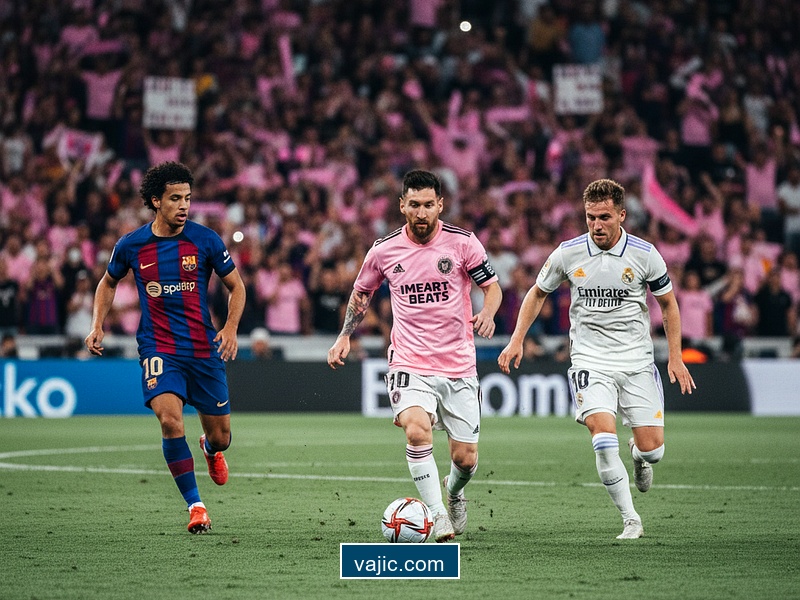
Ignore the sentimental narrative of friends reuniting in South Florida. The report that Lionel Messi has advised Inter Miami's front office to target two specific La Liga stars for the 2026 season is not a request born of nostalgia. It is a calculated tactical intervention. As we approach the 2026 World Cup cycle, Messi anticipates his physical decline. To remain effective in Major League Soccer—a league defined by chaotic transitions and athleticism—he requires a structural overhaul that mimics the control of Spanish football.
This recruitment strategy signals a shift in Inter Miami’s tactical identity. The current reliance on Jordi Alba’s overlaps and Sergio Busquets’ deep progression is sustainable now, but by 2026, the engine room requires reinforcement. Messi’s request targets the one commodity MLS struggles to produce: high-level positional intelligence (juego de posición).
The Analysis: Protecting the Zero-Work-Rate Asset
To understand why Messi is pointing toward La Liga, one must analyze his heat maps from the past 12 months. He no longer drifts wide. He occupies the central channel and the right half-space, often walking while the opposition possesses the ball. This is efficient, but it leaves a defensive void. In a standard 4-3-3, the right-sided central midfielder and the right-back are often overrun.
MLS teams exploit this by overloading that flank. Messi’s advice to sign La Liga talent addresses the "Rest Defense" structure. He needs players schooled in Spanish academies who understand how to defend with the ball. By keeping possession for extended periods—La Pausa—the team reduces the number of defensive transitions they must face.
Target Profile 1: The Press-Resistant Interior
The first tactical gap Miami must fill for the 2026 iteration is the "Interior" role. Currently, Miami’s midfield relies on athleticism to recover balls lost in transition. However, a La Liga recruit brings a different skillset: 360-degree scanning and press resistance.
When Messi drops deep to receive, he drags markers with him. He needs a midfielder who can instantly recognize this movement and rotate into the vacated space behind the defensive line. This "Third Man Run" is a staple of Spanish football but is rarely executed with precision in MLS.
| Tactical Attribute | Current MLS Profile | Required La Liga Profile |
|---|---|---|
| Progression | Carries via dribbling | Vertical passing lines |
| Reaction to Press | Back pass / Clearance | Half-turn / Breaking lines |
| Space Occupation | Static positioning | Dynamic interchange |
The table illustrates the disparity. Messi requires the "Required La Liga Profile" to function as a stationary playmaker. If he has to drop to his own 18-yard box to collect the ball because his midfielders cannot break a press, his goal threat vanishes. The recruitment advice is essentially an insurance policy for his own energy levels.
Target Profile 2: The Inverted Wide Playmaker
The second profile likely requested is a technically gifted wide player who operates in the pockets—a Griezmann-esque figure or a creative winger typical of Real Sociedad or Villarreal. Why? Because the pitch is too large for Messi to span alone.
In 2026, Miami will likely utilize an asymmetric formation. With Messi operating centrally but drifting right, the team needs a player on the left who does not just hug the touchline but tucks inside to form a box midfield. This creates a numerical superiority (4v3) in the center of the park. Most MLS wingers operate on vertical rails; they run fast and cross. Messi requires diagonal operators.
By signing a La Liga veteran for this role, Miami ensures that when Messi possesses the ball, he has a passing option less than 15 yards away. Short passing triangles (rondos) demoralize athletic opponents. It forces defenders to stop sprinting and start thinking, an area where La Liga veterans consistently outperform MLS defenders.
The 2026 Timeline: A Structural Necessity
We must also analyze the timing. The 2026 MLS season coincides with the North American World Cup. The spotlight on Miami will reach unprecedented levels. Tactically, this creates a unique pressure cooker. Opposing teams will not just sit back; they will high-press Miami to embarrass them on the global stage.
A 39-year-old Messi cannot press. Suarez (if he remains) or his replacement cannot press with high intensity. Therefore, the defensive strategy must rely on possession as defense. If Miami keeps the ball for 65% of the match, they only need to defend for 35% of it. This strategy fails instantly if the supporting cast lacks technical security.
This is the core of Messi's advice. He understands that sheer talent wins moments, but structural possession wins leagues. By targeting La Liga stars, he is not looking for goal scorers; he is looking for players who can execute the "Safety Pass" and the "Tempo Control" required to manage games in the Florida heat without engaging in a track meet.
Ultimate