
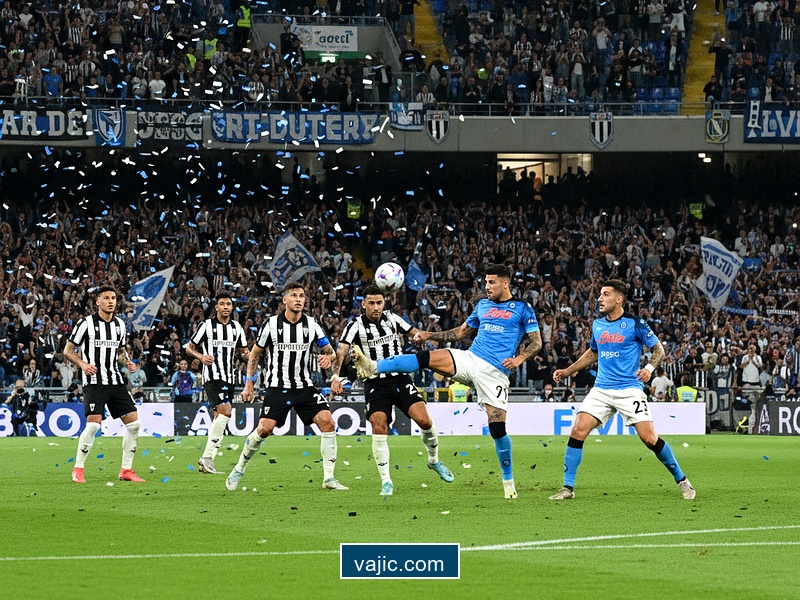
The rain in Udine falls differently than it does in Naples. In the south, the rain is a chaotic, tropical outbursts that floods the gutters and sends scooters scattering. In the north, specifically here at the Bluenergy Stadium in Friuli, it is cold, persistent, and industrial. It soaks into the bones. It makes the ball skid and the grass heavy. It is a climate for workers, for grinders, for men who understand the weight of labor.
Romelu Lukaku stepped onto this sodden turf not just as a striker for Napoli, but as a man perpetually on trial. The narrative of his career has become a tragic cycle of conquest and alienation. He conquers a city, he kisses the badge, and then fate—or perhaps his own restlessness—tears the script apart. Yet, against Udinese, amidst the physical brutality of the Serie A mid-table grinders, we witnessed something that transcended the simple mechanics of a football match. We witnessed a man fighting to define his final act.
The fixture list read Udinese vs. Napoli, but the subtext was entirely focused on the Belgian colossus. With the departure of Victor Osimhen—a shadow that still looms large over the Partenopei—Lukaku was brought in by Antonio Conte not to replicate the Nigerian’s acrobatic flair, but to provide a different kind of violence. He is the battering ram intended to break down the fortified gates of Italian defenses. In Udine, the gates were barred, and Lukaku was asked to run through them headfirst.
The Analysis: A War of Attrition
To understand the performance in Udine, one must first strip away the expectations of modern aesthetic football. This was not a game for the tacticians who obsess over passing triangles and false nines. This was archaic warfare. Udinese’s defensive line, anchored by Jaka Bijol, is notorious for its physicality. They do not mark space; they mark bodies. For ninety minutes, Lukaku played with a defender draped over his back like a wet coat.
In the 23rd minute, the contrast was stark. A long ball from Rrahmani bypassed the midfield entirely. In previous seasons, Osimhen would have chased this into the channels, using searing pace to stretch the play. Lukaku did the opposite. He planted his feet. He lowered his center of gravity. He invited the contact. When the collision came, the sound was audible even over the chanting of the Curva Nord. Lukaku didn't budge; the defender bounced off him. This is the "Conte-ball" blueprint: the striker as a pivot, a wall against which the team bounces its attacks.
Critics often point to Lukaku's first touch as his fatal flaw. They circulate GIFs of balls bouncing off his shin. But they miss the psychological warfare he inflicts. By the 60th minute, the Udinese defense was visibly gasping. Wrestling a man of that size, who possesses the agility of a heavyweight boxer, drains the legs faster than any sprint. He was eroding their resistance, minute by agonizing minute.
| Metric | Lukaku vs. Udinese | Season Avg. |
|---|---|---|
| Duels Won | 9 | 4.5 |
| Fouls Drawn | 5 | 2.2 |
| Touches in Box | 3 | 6.8 |
The Moment of Redemption
The defining moment arrived late in the second half. The match had descended into a scrappy, disjointed affair—exactly the kind of mire Udinese thrives in. Napoli needed a savior, but they didn't need a magician; they needed a executioner.
When the cross came in from the left flank, floating awkwardly in the swirling wind, Lukaku was surrounded by three black-and-white jerseys. A lesser striker waits for the ball to land. A fearful striker looks for the referee. Lukaku attacked the space. He bullied his marker out of the aerial zone—a purely physical assertion of dominance—and met the ball with a thunderous header.
It wasn't pretty. It wasn't the silky dribbling of Kvaratskhelia. It was brute force applied with precision. The ball hit the net before the goalkeeper could even adjust his feet. In that split second, the silence of the Udine crowd was the loudest validation of Conte’s gamble. Lukaku roared, not with joy, but with relief. It was a roar that echoed all the frustration of his turbulent summer, the chaotic exit from Roma, and the lingering doubts of the Napoli faithful.
The Legacy in the Balance
There is a tragic element to Lukaku’s career that often goes unnoticed. He is one of the most prolific goalscorers in international football history, yet he plays with the desperate energy of a man trying to prove he belongs. He has worn the shirts of Manchester United, Chelsea, Inter, and now Napoli, yet he remains a nomad. He seeks a home, but perhaps he is only truly at home in the conflict of the penalty box.
This match against Udinese serves as a microcosm of his current existence. He did not touch the ball often. He was isolated for long stretches. He looked frustrated, gesturing wildly at his teammates to push higher up the pitch. But when the critical moment arrived, he delivered. This is the bargain Napoli has made. They have traded the fluid, high-pressing dynamism of the Spalletti era for the rigid, efficient brutality of the Conte-Lukaku axis.
For the fans traveling back south, soaked but victorious, the debate will rage on. Is this sustainable? Can a team rely so heavily on the broad shoulders of one aging giant? But for tonight, the answer is irrelevant. In the cold rain of Udine, Romelu Lukaku carried the heavy crown of Naples. He didn't ask for love; he demanded respect. And as he walked off the pitch, limping slightly, battered and bruised, he looked every bit the tragic hero Napoli loves to worship. The downfall predicted by so many has been postponed. The redemption arc continues, one bruised defender at a time.