
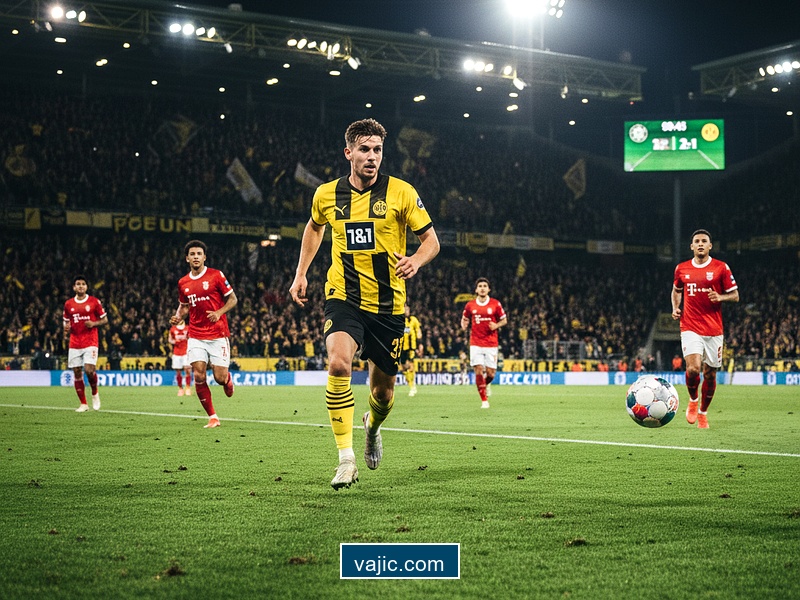
There is a specific kind of silence that falls over a footballer in the eighty-ninth minute. The crowd may be roaring, the drums in the Kurve might be thundering, but inside the body, there is only the screaming protest of lactic acid. Most players listen to that scream. They slow down. They conserve. They drift. Lennard Maloney does not listen. He accelerates.
In a league celebrated for its technical wizardry and tactical intricate systems, Maloney has carved his name into the annals of the Bundesliga not with a silken touch or a thunderous volley, but with the sheer, unadulterated will to suffer. The news confirmed it this week: the Heidenheim midfielder has broken the all-time Bundesliga record for distance covered in a single match. It is a statistic that usually serves as a footnote, but for Maloney, it is the headline of his entire existence. It is the metric of his redemption.
This record is not merely a number on a spreadsheet. It represents a philosophical stance against mediocrity. For a player who was once deemed surplus to requirements, who toiled in the shadows of the lower leagues, running until the lungs burn is not a chore. It is a privilege. It is the rent he pays for his place on the stage he fought so desperately to reach.
The Architecture of Endurance
To understand the magnitude of this feat, one must look backward at the trajectory of Maloney’s career. The path to the Bundesliga elite is rarely a straight line, but Maloney’s route resembled a jagged scar. Born in Berlin to an American father and German mother, he spent his youth at Union Berlin, a club known for its working-class ethos. Yet, even there, he struggled to break through. The rejection was quiet but palpable.
He moved to Borussia Dortmund II. In the reserves of the German giants, amidst teenagers destined for Real Madrid or Manchester City, Maloney became the elder statesman of grit. While others auditioned with step-overs, Maloney auditioned with sweat. He learned the dark arts of the defensive midfield—the unglamorous shuttling, the passing lane obstruction, the tactical fouling. He became a specialist in the invisible work that allows others to shine.
"Talent can take a day off. Talent can get injured. But the will to outrun your opponent? That is a choice you make every single morning."
His move to 1. FC Heidenheim was the turning point. Under the tutelage of Frank Schmidt—a manager who values character over currency—Maloney found a spiritual home. Heidenheim is not a club of superstars. They are the underdogs of the top flight, a team that must collectively run an extra marathon just to bridge the gap in technical quality against the likes of Bayern Munich or Bayer Leverkusen. Maloney became the embodiment of this struggle. He became the engine room of a team that refuses to die.
A Record Written in Sweat
Breaking the distance record requires a specific set of match circumstances. One does not simply decide to run 14 kilometers. The game must demand it. It requires a relentless opponent, a tactical system that demands high pressing, and a personal refusal to yield space. Maloney covers ground not just for himself, but for his teammates. When the right-back pushes up, Maloney is there to cover the gap. When the center-back is dragged wide, Maloney slots into the hole. He is the mortar in the brick wall.
| Metric | Elite Midfielder Avg | Lennard Maloney |
|---|---|---|
| Distance (km/game) | 10.8 - 11.5 km | 13.0+ km (Record) |
| Sprints per 90 | 20 - 25 | 30+ |
| Intensive Runs | 60 - 70 | 85+ |
The statistics paint a picture of a man possessed. But the visual is even more striking. Watch him in the dying moments of a match. His chest heaves, his face is slick with sweat, his socks are rolled down. Yet, when the ball breaks loose, he is the first to react. This record serves as a validation of a playing style that is often mocked in the modern era of "luxury players." Maloney proves that the biological machine—the human body pushed to its absolute limit—remains the most critical instrument in the sport.
The American Engine
This achievement resonates beyond the borders of Germany. For the United States Men's National Team, Maloney represents a distinctive archetype. The USMNT has talent, flair, and speed. But do they have enough suffering? Do they have enough players willing to do the dirty work that Maloney executes with such robotic precision?
His integration into the national team setup has been a slow burn, much like his club career. He does not offer the flashy dribbles of a Pulisic or the playmaking vision of a Reyna. Instead, he offers insurance. He offers the guarantee that no matter how chaotic the game becomes, one man will never stop running. In international tournaments, where games are often decided by fatigue and lapses in concentration, a player with Maloney’s engine is worth his weight in gold.
There is a heroic quality to his monotony. He clears the ball. He chases the winger. He tracks back. He repeats this loop until the final whistle blows. By breaking the Bundesliga record, he has forced the world to watch him. He has taken the most mundane aspect of the sport—running—and elevated it to an art form.
Lennard Maloney’s story is not a fairytale of overnight success. It is a biography written in sweat, rejection, and eventual triumph. He did not ask for the spotlight; he ran until the spotlight had no choice but to find him. As long as there is grass to cover and an opponent to chase, the engine of Heidenheim will keep turning, reminding us all that sometimes, the greatest talent is simply the refusal to stop.