
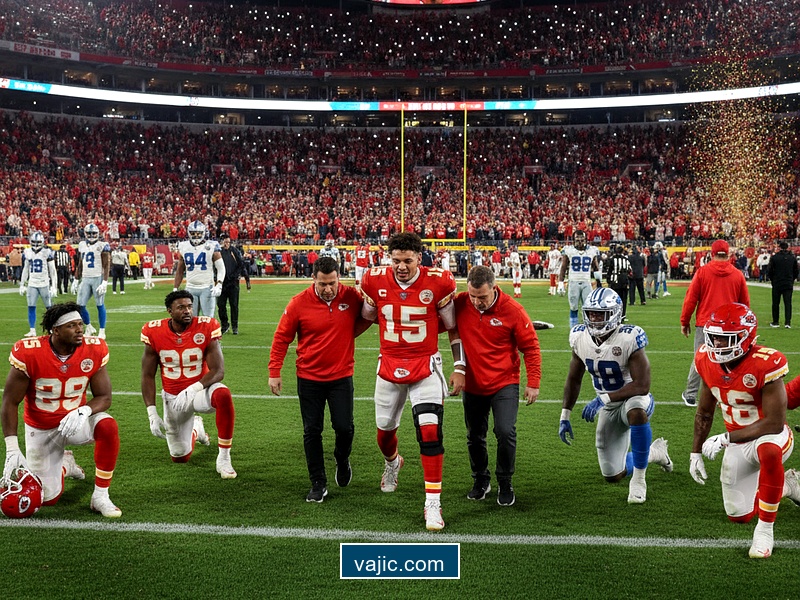
The confirmation of Patrick Mahomes’ torn ACL represents more than just the loss of a franchise player; it signifies the total collapse of the NFL’s most complex defensive paradox. For the last half-decade, defensive coordinators have designed game plans specifically to counter a quarterback who defies structural logic. Mahomes does not merely execute an offense; he creates an external layer of play extension that forces defensive backs to cover for six seconds rather than the standard three.
With his removal from the equation, Andy Reid faces a schematic reset that goes far deeper than simply "next man up." We are about to witness the Chiefs’ offense stripped of its supernatural element, forcing a regression to pure West Coast Offense (WCO) mechanics. The question isn't about morale; it is about spacing, leverage, and the harsh reality of passing windows that are about to get significantly tighter.
The Death of the 'Second Play'
To understand the tactical void Mahomes leaves, one must analyze the "Second Play." This is the phase of the down that begins when the primary read is covered and the pocket breaks down. Statistically, Mahomes leads the league in Expected Points Added (EPA) on plays lasting longer than 4.5 seconds.
His heat maps show a distinct tendency to drift deep and right, dragging linebackers out of their zones and forcing safeties to abandon their leverage. This creates "conflict zones" where receivers like Travis Kelce find soft spots in the coverage breakdown. Without this threat, the Kansas City offense becomes linear. The backup quarterback—regardless of who is under center—will operate strictly within the pocket's timing.
This changes the defensive assignment from "plastering" (sticking to a receiver indefinitely) to "driving." Defensive backs can now aggressively jump routes, knowing the ball must come out on time. The hesitation caused by the threat of a Mahomes scramble is gone. Cornerbacks will now squat on short routes, daring the Chiefs to throw deep without their primary deep-ball architect.
"When you remove the improvisation, you remove the fear. Defenses no longer have to defend every blade of grass; they only have to defend the play call."
Formation Regression: The Rise of 12 and 13 Personnel
Andy Reid is a master of adaptation. Without the vertical stretch capability Mahomes provides, Reid will likely pivot to a horizontal, power-based attack. We should anticipate a drastic reduction in 11 personnel (1 RB, 1 TE, 3 WR) and a spike in heavy sets.
By utilizing 12 personnel (1 RB, 2 TE) or even 13 personnel, the Chiefs can manufacture protection for a less mobile quarterback. This creates extra gaps in the run game and forces the defense to keep linebackers on the field rather than lighter nickel corners. The goal shifts from scoring quickly to controlling the clock and shortening the game.
| Metric | With Mahomes (Avg) | Projected w/o Mahomes | Tactical Implication |
|---|---|---|---|
| Shotgun Usage | 88% | 60% | More play-action from under center. |
| Box Defenders | 6.2 | 7.5+ | Harder to run; crowded interior lanes. |
| Deep Ball Rate (>20 yds) | 14% | 6-8% | Compressed field; requires sustained drives. |
Defensive Adjustments: Collapsing the Two-High Shell
For years, the "Mahomes Rules" dictated defensive play. This involved the Vic Fangio-style two-high safety shell (Cover 2 or Quarters), designed to keep a lid on the defense and force Mahomes to be patient. It was a strategy of containment.
With Mahomes entering rehab—a process Tom Brady noted will be "tough" and rigorous—defensive coordinators will immediately scrap this approach. We will see a league-wide shift against Kansas City toward Single-High Safety looks (Cover 1 or Cover 3).
By dropping a safety into the box (the "Robber" or "Hole" player), defenses can double-team the run game and clog the middle of the field where Travis Kelce operates. This forces the backup quarterback to throw to the perimeter—specifically, the "outside the numbers" throw. Statistically, this is the lowest-percentage throw for non-elite quarterbacks. Defenses will effectively say: "We are taking away the middle. Beat us on the sidelines with your arm strength."
The Kelce Conundrum: From Freelance to Fixed
Travis Kelce's reaction regarding the injury ("It was almost like it wasn't real") highlights the emotional impact, but the tactical impact on his game is severe. Kelce and Mahomes share a non-verbal connection based on "option routes." Kelce often alters his route mid-stem based on the leverage of the linebacker or safety. This requires a quarterback who sees the field identically and can adjust his throwing platform instantly.
A backup quarterback cannot support this level of variance. Consequently, Reid must simplify Kelce's route tree. The "freelancing" into open space must stop. Kelce will be forced into static routes—defined depths and cuts—to ensure the quarterback knows exactly where he will be. While this minimizes turnover risk, it neutralizes Kelce’s greatest superpower: his ability to be right when the play design is wrong.
The Chiefs are not just losing a player; they are losing the system's error-correction mechanism. Without the threat of the deep ball or the scramble, the field becomes a condensed grid of tight windows and heavy boxes. The coming weeks will not be a test of willpower, but a brutal examination of Andy Reid’s ability to manufacture yards in a telephone booth.