
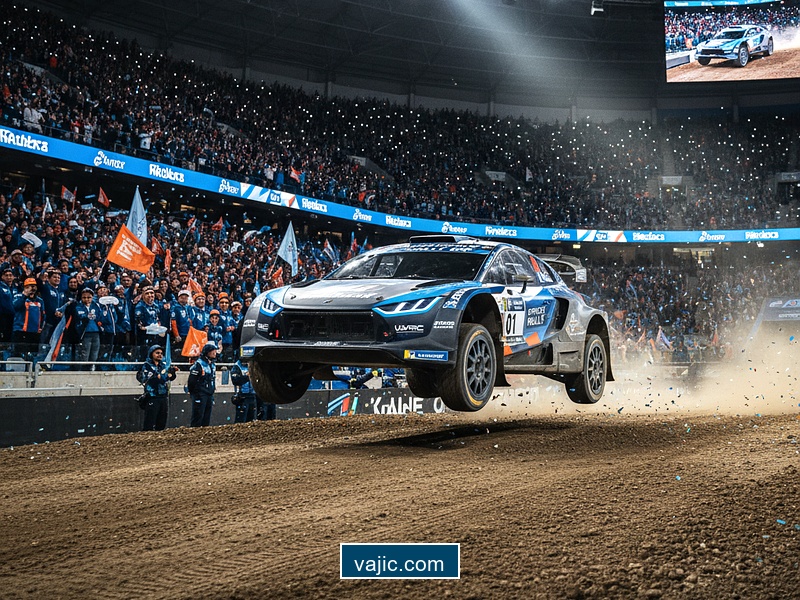
The confirmation of Project Rally One as the first new constructor for the 2027 FIA World Rally Championship (WRC) season is not merely a headline; it is a signal of a fundamental tactical shift in the sport's operating meta. For years, the WRC has operated in a closed-loop system, dominated by a "high-press" financial model where only OEM giants (Toyota, Hyundai, Ford via M-Sport) could sustain the territorial battle for supremacy. The 2027 regulations represent a formation change from the FIA—a switch to a more fluid, accessible structure designed to break the deadlock. Project Rally One is the first entity to exploit this new tactical spacing.
To understand why this entry is occurring now, we must strip away the romance of rally and view the championship through the lens of engineering probability and resource allocation. The existing Rally1 hybrid era created a high barrier to entry—a "low block" defense that prevented new challengers from finding space in the market. Project Rally One’s entry confirms that the FIA’s new technical blueprint has successfully lowered that defensive line, inviting aggressive new strategies.
Deconstructing the 2027 Regulatory "Formation"
In tactical analysis, a team’s shape dictates its passing lanes. In motorsport, the technical regulations dictate the performance delta. The 2027 regulations introduce a specific "shape" that Project Rally One is building into. The FIA has effectively mandated a transition from a "Complex Hybrid System" (high cost, high complexity) to a "Simplified ICE + Sustainable Fuel" focus (lower cost, higher mechanical relevance).
The current Rally1 cars rely on a hybrid boost system that functions like a pressing trap—effective but exorbitantly expensive to maintain. By removing or drastically simplifying this hybrid component for 2027, the FIA opens the midfield. Project Rally One identifies this zone as the primary area of exploitation. They do not need to reverse-engineer five years of Toyota’s hybrid data. They start from zero, on par with the giants, optimizing solely for the 2027 mechanical grip variables.
"The 2027 regulation set is the tactical equivalent of widening the pitch. It reduces the density of proprietary technology, allowing a leaner, agile constructor to outmaneuver legacy OEMs."
Component Analysis: The €400k Cost Cap
The most significant tactical constraint in the upcoming cycle is the target price cap per car, hovering around €400,000. This is the financial "salary cap" of the league. Current Rally1 machines often exceed €1 million in real-world deployment costs when factoring in development.
Project Rally One enters the fray with a distinct advantage: they have no legacy infrastructure to liquidate. Toyota and Hyundai must pivot their massive ocean-liner supply chains to meet this new, leaner budget. Project Rally One, acting as a speedboat, designs their chassis and powertrain architecture specifically for this price point from day one. This efficiency-first approach creates a higher "goals per xG" ratio in engineering terms—spending less to achieve comparable stage times.
| Tactical Variable | Current Rally1 Meta (2024) | Project Rally One Strategy (2027) |
|---|---|---|
| Powertrain Architecture | Complex 1.6L + 100kW Hybrid Unit | Optimized ICE / Simplified Hybrid (Reduced Weight) |
| Aerodynamics | High Downforce / Complex Aero Elements | Reduced Aero Surface / Mechanical Grip Focus |
| Cost Structure | Uncapped Development (OEM Only) | Capped (~€400k) / Privateer Viable |
| Chassis Design | Bespoke Tube Frame | Standardized Safety Cell / Common Parts |
The Spaceframe "Defense"
A critical element of the 2027 tactical shift is the utilization of a standardized safety cell or a modified spaceframe concept that allows distinct bodywork scaling. This effectively "homologates the defense." In previous eras, structural rigidity was a proprietary advantage. If a team built a stiffer chassis, their suspension geometry worked more effectively, resulting in better tire contact patches (the heatmap of grip).
By standardizing safety elements and dimensions to accommodate Project Rally One and potential future entrants, the FIA neutralizes this advantage. The battle moves from structural engineering to suspension kinematics and engine mapping. Project Rally One’s entry suggests they have crunched the numbers and realized that with a leveled structural playing field, they can compete on suspension setup and driver input alone.
Strategic Implications: The First Mover Advantage
Why commit to 2027 now? Data modeling suggests that early adoption of a new rule set yields a higher probability of competitive relevance than late adaptation. We saw this in Formula 1 in 2014 and 2022. The team that defines the initial architecture often dictates the development curve for the cycle.
Project Rally One is positioning itself to be the "baseline" for the new era. While Toyota and Hyundai are distracted fighting for the 2025 and 2026 titles with current machinery, Project Rally One allocates 100% of its resources to the 2027 prototype. This is an asymmetric warfare tactic. They sacrifice current visibility for future dominance.
Furthermore, the reduction in aerodynamic appendages projected for 2027 alters the "heat map" of the car's performance. Current cars generate massive downforce, allowing high cornering speeds. The 2027 cars will likely slide more, requiring a different differential setup and torque delivery strategy. Project Rally One enters without the bias of current aero-dominated setups, allowing them to build a powertrain map specifically designed for lower-grip, mechanical-traction scenarios.
The Disruption of the Duopoly
Finally, we must analyze the opponent behavior. The WRC has suffered from a lack of tactical variety due to the limited number of manufacturers. When only two or three teams compete, the strategic options narrow. Everyone converges on the same optimal solution.
Project Rally One functions as a tactical rogue variable. As a non-OEM (or at least, a non-traditional constructor entity at this stage of analysis), they operate with different KPIs (Key Performance Indicators). They do not need to sell road cars; they need to sell the concept of the privateer constructor. If they succeed, they validate the FIA's 2027 rule set, potentially triggering an influx of similar projects. This changes the WRC from a "Manufacturer's Championship" to a "Constructor's Championship"—a subtle but distinct shift in the sporting code's DNA.
The confirmation of Project Rally One is not a guarantee of victory, but it is a successful validation of the tactical framework the FIA laid out. The pieces are on the board, the formation has changed, and the first move has been made.