
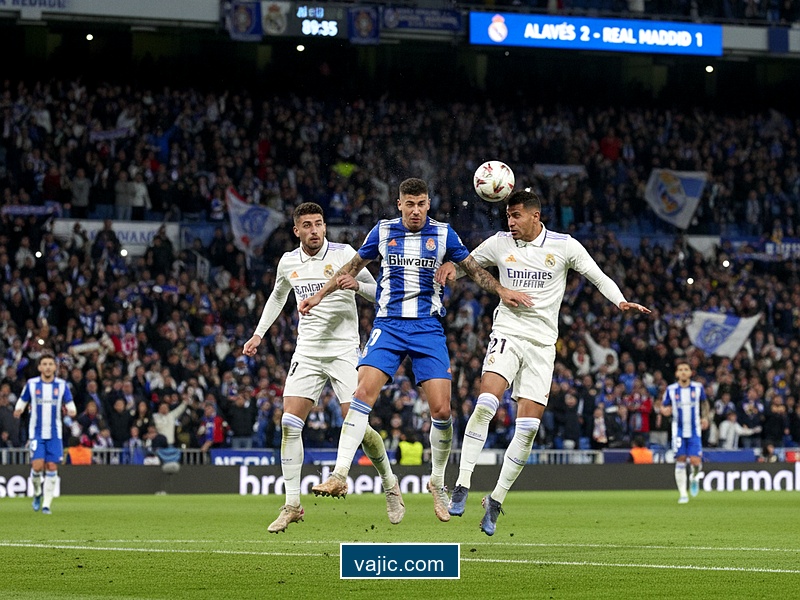
The scoreboard at Mendizorrotza may reflect a routine victory for the champions, but the tactical reality underneath the surface was anything but standard. Matches between a heavy favorite and a disciplined underdog often devolve into a battle of attrition—a sledgehammer striking a wall. However, this La Liga encounter offered a masterclass in spatial manipulation rather than blunt force. Real Madrid did not simply outrun Alavés; they out-positioned them, dismantling a rigid defensive structure through a calculated geometric shift in midfield possession.
Luis García Plaza set up his side not to play football, but to solve a problem. The problem was Real Madrid’s verticality. His solution—a hyper-compact low block—worked for forty minutes until the structural integrity of the Alavés midfield collapsed under the weight of Madrid’s asymmetrical overload. This wasn't about passion or grit; it was about the failure of a 5-4-1 system to cope with a fluid 4-2-2-2 box midfield.
The Alavés Stranglehold: 5-4-1 Mechanics
To understand how Real Madrid won, we must first dissect the obstacle they faced. Alavés deployed a classic 5-4-1 defensive shape without the ball. This is distinct from a 3-5-2 or a 5-3-2 because of the flatness of the midfield four. The objective of this formation is to eliminate the half-spaces—the vertical channels between the center-back and the full-back.
Typically, teams attacking a low block attempt to stretch the pitch horizontally. They put wingers on the touchline to force the defensive line to widen, creating gaps in the middle. Plaza anticipated this. By utilizing three center-backs, Alavés could allow their wing-backs to aggressively close down Madrid’s wide players without sacrificing central coverage.
The heat maps from the first half confirm Plaza’s intent. Alavés' average defensive line height was just 32 meters from their own goal line. They surrendered the flanks entirely in the middle third, compressing the vertical distance between their defensive line and midfield line to less than 12 yards. This compression denies players like Jude Bellingham or Rodrygo the ability to turn between the lines. If a Madrid player received the ball centrally, they were immediately swarmed by three blue-and-white shirts.
Madrid’s Solution: The Box Midfield Overload
Carlo Ancelotti recognized that traditional width would yield nothing against a back five. If the wingers stayed wide, they would be isolated 1v2 against the Alavés wing-back and the wide center-back. Madrid’s adjustment was to invert the pyramid. Instead of stretching play, they cluttered the center to force a malfunction in the Alavés marking scheme.
Madrid shifted into a distinct 4-2-2-2 possession structure.
| Role | Player(s) | Tactical Function |
|---|---|---|
| The Double Pivot | Tchouaméni / Valverde | Circulate play and protect against counters. |
| The High Interiors | Bellingham / Modric | Occupy the half-spaces, pinning the Alavés pivots. |
| The False Width | Carvajal / Mendy | Provide the *threat* of width without staying wide. |
| The Drifters | Vinícius Jr / Rodrygo | Roaming inside to create numerical superiority. |
This shape created a "box" in the midfield (Tchouaméni, Valverde, Bellingham, Modric) that outnumbered the two central midfielders of Alavés. This numerical superiority (4v2) presented the Alavés midfield pair with an impossible choice: step up to press Tchouaméni and leave Bellingham free behind them, or stay deep and allow Madrid’s base pivot time to pick a perfect pass.
Deciphering the Breakthrough
The opening goal arrived not through magic, but through this specific structural stress. Focus on the movement of Vinícius Jr leading up to the goal. Typically a touchline hugger, Vinícius drifted centrally, occupying the same vertical channel as the striker. This dragged the Alavés right wing-back inward, creating a vacuum of space on the wide left.
Simultaneously, Jude Bellingham made a "dummy run" toward the ball. This movement pulled one of the Alavés center-backs out of the defensive line by three yards. In a low block, a three-yard displacement is fatal. It creates a lane.
Real Madrid exploited this instantly. With the Alavés defense narrowed to deal with the central overload of Vinícius and Bellingham, the switch of play to the onrushing full-back was on. The Alavés defense had to shuffle across the pitch. Data shows that lateral defensive shifts are where organization breaks down. The split-second delay in the Alavés left-back closing down the cross allowed the box overload to pay dividends. Madrid had three players attacking the penalty spot against a disorganized, back-pedaling defensive line.
Rest Defense and Nullifying the Counter
While the offensive movements garner the highlights, Real Madrid’s "Rest Defense" ensured the result. Playing against a low block carries the risk of being hit on the counter-attack, especially with players like Samu Omorodion (or equivalent target men) looking to run into channels.
Ancelotti utilized a 2-3 rest defense structure. The two center-backs stayed deep, while the three midfielders (often involving Valverde tucking in) formed a shield in front of them. This structure is designed for "counter-pressing." The moment Madrid lost the ball in the final third, three players were immediately positioned to cage the Alavés outlet player.
The stats support this dominance. Alavés attempted 14 transitions from their defensive third. Only two reached the Madrid penalty area. The other 12 were extinguished within 6 seconds of the turnover. By suffocating the outlet pass, Madrid sustained pressure, forcing Alavés to defend wave after wave of attacks without respite.
The Half-Space Conclusion
This match serves as a blueprint for dismantling the 5-4-1. While pundits might point to individual brilliance or fatigue, the analytical truth lies in the overload of central zones. Alavés relied on a system designed to defend horizontal width and vertical runs. Madrid countered with a system designed to dominate the pockets between those zones.
By refusing to stay wide and instead flooding the central corridors with technical quality, Real Madrid turned Alavés' compactness against them. The defenders bumped into each other, unsure who to mark as Vinícius dropped deep and Bellingham surged forward. It was a victory of tactical geometry, proving that sometimes the best way to break a wall is not to hammer it, but to dismantle the bricks one by one from the inside.