
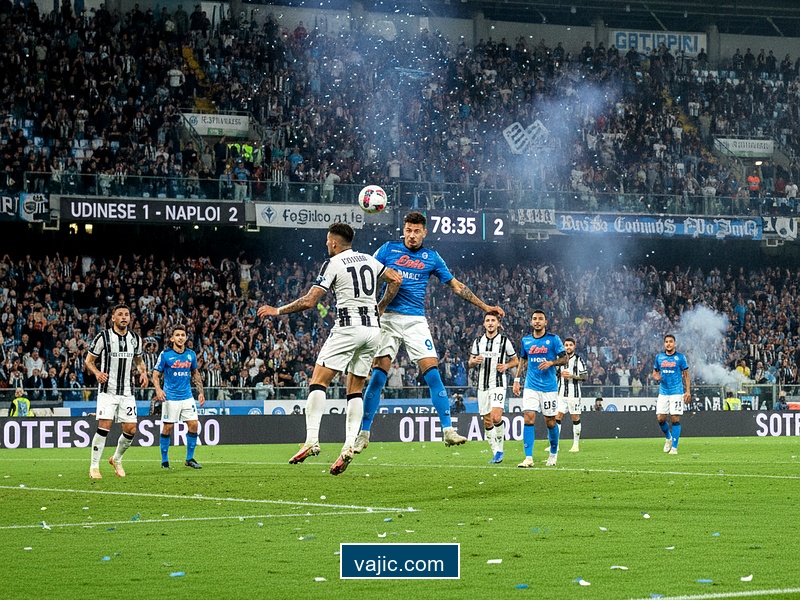
Football, at its highest tactical level, is a war over geometry. The narrative often follows the emotion of the crowd or the brilliance of a solo goal, but the truth of the result in Udine lies entirely within the structural integrity of two conflicting systems. When Udinese hosted Napoli, we witnessed a friction point between a rigid, space-denying 3-5-2 low block and a high-possession 4-3-3 that ran out of ideas. The result was not an accident of fate; it was the logical conclusion of a pitch constricted by discipline and defined by the failure of the visitors to solve a complex spatial puzzle.
The Mechanics of the 5-3-2 Low Block
To understand why Napoli struggled to generate high xG (Expected Goals) opportunities, one must dissect the defensive shape employed by Udinese. While ostensibly a 3-5-2 in possession, out of possession, the hosts collapsed into a flat 5-3-2. This is standard practice in Serie A, but the execution here was distinct due to the vertical compaction.
Udinese maintained a distance of roughly 12 to 15 meters between their defensive line and their midfield trio. This compression creates a "kill zone" in the central areas. Napoli, relying on vertical passes from their pivot into the feet of dropping forwards or attacking midfielders, found those passing lanes physically blocked by bodies.
"The data suggests Napoli held 65% of the ball, but possessed it in harmless zones. Possession without penetration is merely procrastination."
By refusing to step up and engage Napoli’s center-backs, Udinese’s strikers allowed the visitors to circulate the ball harmlessly across the backline. This was a calculated risk. It invited Napoli forward, pulling their defensive line higher, which inherently created the space behind for Udinese to exploit later. The discipline required to not press the ball carrier, but rather press the space, was the defining feature of the first half.
Napoli’s Isolation on the Flanks
Napoli's primary offensive weapon typically stems from wide isolation situations, particularly on the left flank. In a standard match up against a back four, a winger can isolate a fullback 1v1. Udinese’s system completely neutralized this mechanism.
Because Udinese played with wing-backs and wide center-backs, they created natural 2v1 advantages against Napoli’s wingers. Whenever the ball went wide, the Udinese wing-back would press aggressively, knowing he had the safety net of the wide center-back covering the inner channel. This forced Napoli’s attackers to check back or play negative passes.
| Metric | Napoli (Left Flank) | Napoli (Right Flank) | Udinese Defensive Win Rate |
|---|---|---|---|
| Dribbles Attempted | 14 | 9 | -- |
| Dribbles Successful | 3 | 2 | 78% |
| Crosses Completed | 2 | 1 | 88% Clearance |
The statistics above illustrate the sterility of the wide attack. Napoli attempted to force the issue individually, but the structural superiority of the five-man defensive chain meant that there was rarely a gap to exploit. Without overlapping runs from the Napoli fullbacks—who were often inverted to protect against counters—the wingers remained stranded on an island.
The Half-Space Vacuum
Modern football offense relies heavily on the "half-spaces"—the vertical channels running between the wing and the center. Napoli usually dominates these zones through the movement of their #8s (mezzalas). In this fixture, Udinese’s midfield three operated on a strict lateral shuttle system that denied entry into these pockets.
Heat maps from the match indicate a distinct "U-shape" in Napoli’s possession. The ball moved from center-back to fullback, back to center-back, and across to the other side. There was a notable absence of heat in the Zone 14 (central area just outside the penalty box) and the advanced half-spaces.
Udinese’s central midfielders tracked the runs of Napoli’s counterparts man-for-man when they entered the final third. When a Napoli midfielder attempted to crash the box, an Udinese midfielder tracked him all the way to the goal line, effectively turning the defensive line into a back six at crucial moments. This density made cut-backs impossible. Every time Napoli hit the byline and looked up, they saw a forest of black and white shirts occupying the passing lanes.
Napoli's Rest Defense and Transition Vulnerability
While the focus lies on Udinese’s defense, their offensive output relied on the fragility of Napoli’s "rest defense." Rest defense refers to the structure a team maintains while they are attacking, specifically designed to stop counter-attacks before they begin. Napoli attempted a 2-3 shape (two center-backs, three midfielders/inverted fullbacks) to lock the ball in Udinese's half.
The failure here was in the execution of the counter-press. When Napoli lost the ball, the nearest man often failed to foul or recover instantly. Udinese recognized this sluggish transition speed. Their tactical instruction was clear: the first pass upon recovery must be vertical. They bypassed the midfield entirely, aiming for their target man to hold up play or flick the ball into the channels for onrushing wing-backs.
This verticality stretched Napoli.