
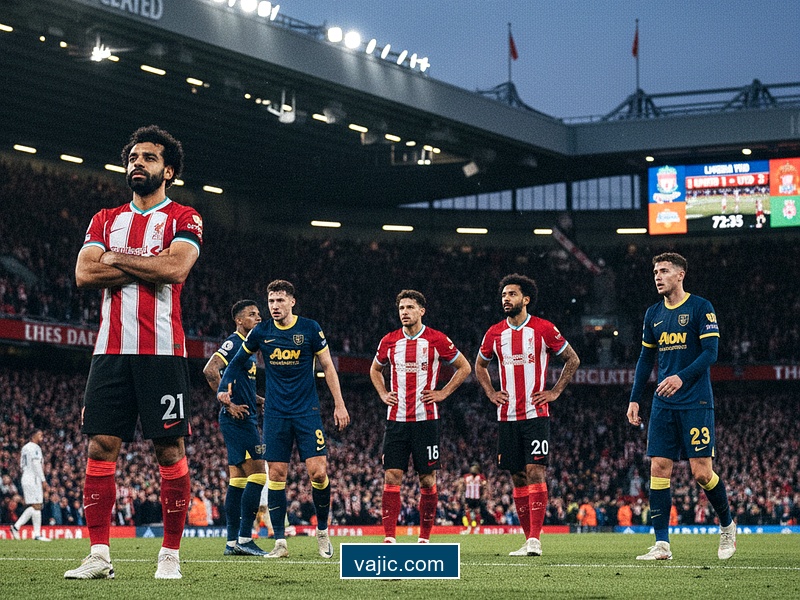
Modern football analysis often suffers from result-based bias. If the three points are secured, the system is deemed functional. However, a granular look at Liverpool’s recent performances under Arne Slot exposes a tactical fault line that persists despite the positive scorelines. While the headlines focus on the drama surrounding Mohamed Salah, the real story lies in the passing networks and spatial occupation data. The "problem" Ian Ladyman alludes to is not merely one of contract negotiations or personality; it is a fundamental clash between Slot’s control-obsessed 4-2-3-1 structure and the chaotic freedom required to maximize an aging inside forward.
To understand why this issue refuses to go away, we must strip away the emotion and look at the mechanics of the new regime. We are witnessing a transition from heavy metal football to a symphonic, yet rigid, possession game. In this shift, the role of the right-winger has fundamentally changed, creating a tactical friction that threatens to undermine Liverpool’s offensive fluidity against elite low blocks.
The Analysis
The root of the tactical disconnect lies in the build-up phase. Under the previous regime, the chaos generated by rapid transitions allowed Salah to isolate defenders while they were backpedaling. Slot’s methodology prioritizes the double pivot—typically two holding midfielders controlling the tempo. This slows the game down.
When the tempo drops, the opposition settles into a compact 4-4-2 or 5-4-1 defensive shape. Salah receives the ball static, facing two banks of defenders, rather than on the run. The heatmap evidence is damning: Salah is spending significant time hugging the touchline to stretch the opponent horizontally. While this aids the team’s structure, it neutralizes Salah’s primary superpower—his diagonal drive toward the goal. He creates space for others, but at the cost of his own goal-scoring threat.
The Inverted Full-Back Paradox
We cannot analyze Salah’s isolation without dissecting the movement of the right-back. The tactical evolution of Trent Alexander-Arnold (or whomever occupies that role) into a distinct midfield auxiliary creates a numerical overload in the center but a desert on the wing.
| Tactical Phase | Klopp Era (Overlap) | Slot Era (Inversion) |
|---|---|---|
| Right Back Movement | Overlapping high and wide | Inverts into "No. 6" or "No. 8" zone |
| Defensive Response | Opponent LB splits focus (2v1) | Opponent LB stays tight on Salah (1v1 + Cover) |
| Salah's Option | Cut inside or pass to overlap | Recycle backward or dribble through 2 men |
As the table illustrates, the lack of an overlapping runner removes the "decoy" that Salah feasted upon for years. Without a fullback bombing past him to drag a defender away, Salah faces constant double-teams. Slot’s system demands the winger hold width to allow the #10 and the inverted fullback to operate centrally. This effectively turns Salah into a touchline creative outlet—a role that wastes his finishing instincts inside the box.
The Pressing Trigger Malfunction
Defensively, the friction is equally palpable. Slot utilizes a zonal pressing structure that relies on cutting passing lanes rather than the heavy metal, man-to-man harassment of the previous era. This requires disciplined positioning and energy conservation.
Salah has never been a high-volume defensive worker, but his burst speed allowed him to be an effective trigger man in a high press. In a zonal block, however, the requirement shifts to scanning and shifting laterally to block angles. When Liverpool’s press is broken, the recovery runs required are long and arduous. Recent match data suggests a disconnect between the front line’s engagement line and the midfield block. Salah often stays high, anticipating a counter that rarely comes because Slot’s team builds slowly from the back upon turnover recovery.
This creates a gap in the "Rest Defense." When possession is lost on the left, the switch of play to the opponent's left-back finds Salah high and wide, but not pressing aggressively. This allows opposition teams to progress the ball easily down Liverpool's right channel, forcing the right-back and right-sided center-back into uncomfortable wide 1v1 duels.